
|
|
 |
|
Last Updated:
Mar 24, 2009 - 3:48:49 AM |
What is poi anyway?
-
Fresh squeezed coconut juice
-
Sour pineapple pudding
-
A Jewish expression of disgust
-
Nutritious food made by pounding taro
Just in case you're ever in the million dollar hot seat, here's everything you need to know about Poi:
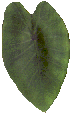
- Poi is made from the popular taro plant: the 14th most cultivated crop on earth.
- Known in scientific circles as Colocasia esculenta, taro is cultivated both in the dry uplands and in marshy land irrigated by streams. The planters of wetland taro built walls of earth reinforced with stone to enclose the taro patch, or lo`i .
- Although taro is eaten around the world, only Hawaiians make poi. Traditionally they cooked the starchy, potato-like taro root, or corm, for hours in an underground oven called an imu. Then they pounded the taro corms on large flat boards called Papa ku`i`ai, using heavy stone poi pounders called pohaku ku`i `ai. The taro was pounded into a smooth, sticky paste called pa`i`ai, then stored air tight in ti leaf bundles and banana sheaths for storage or future trading. By slowly adding water to the pa`i`ai, which was then mixed and kneaded, the perfect poi consistency was created. 4) Poi was traditionally enjoyed with fresh fish, seaweed, breadfruit and sweet potato -- an incredibly tasty and nutritious meal. And when it came to eating poi -- fingers were the utensil of choice. One, two, or three fingers to scoop out the pudding -- two finger poi was considered the best! And many Hawaiians loved their poi fermented a bit, giving it a unique, slightly sour taste.
- The bowl of poi was considered so important and sacred a part of daily Hawaiian life that whenever a bowl of poi was uncovered at the family dinner table, it was believed that the spirit of Haloa, the ancestor of the Hawaiian people, was present. Because of that, all conflict among family members had to come to an immediate halt.
- Poi is also a common term for a variety of other things, including fire poi for dancing, Jakarta POI for Apache, and P.O.I. (GPS Point of Interest).
Here is the USDA's nutritional makeup of Poi.
NDB No: 11349
| Nutrient |
Units |
Value per 100 grams of edible portion |
Sample Count |
|
Proximates |
|
Water |
g |
71.64 |
2 |
|
Energy |
kcal |
112 |
0 |
|
Energy |
kj |
469 |
0 |
|
Protein |
g |
0.38 |
2 |
|
Total lipid (fat) |
g |
0.14 |
1 |
|
Carbohydrate, by difference |
g |
27.23 |
0 |
|
Fiber, total dietary |
g |
0.4 |
0 |
|
Ash |
g |
0.61 |
1 |
|
Minerals |
|
Calcium, Ca |
mg |
16 |
1 |
|
Iron, Fe |
mg |
0.88 |
1 |
|
Magnesium, Mg |
mg |
24 |
1 |
|
Phosphorus, P |
mg |
39 |
1 |
|
Potassium, K |
mg |
183 |
2 |
|
Sodium, Na |
mg |
12 |
2 |
|
Zinc, Zn |
mg |
0.22 |
0 |
|
Copper, Cu |
mg |
0.166 |
0 |
|
Manganese, Mn |
mg |
0.370 |
0 |
|
Selenium, Se |
mcg |
0.7 |
0 |
|
Vitamins |
|
Vitamin C, total ascorbic acid |
mg |
4.0 |
0 |
|
Thiamin |
mg |
0.130 |
0 |
|
Riboflavin |
mg |
0.040 |
0 |
|
Niacin |
mg |
1.100 |
0 |
|
Pantothenic acid |
mg |
0.293 |
0 |
|
Vitamin B-6 |
mg |
0.273 |
0 |
|
Folate, total |
mcg |
21 |
0 |
|
Folic acid |
mcg |
0 |
0 |
|
Folate, food |
mcg |
21 |
0 |
|
Folate, DFE |
mcg_DFE |
21 |
0 |
|
Vitamin B-12 |
mcg |
0.00 |
0 |
|
Vitamin A, IU |
IU |
20 |
0 |
|
Vitamin A, RE |
mcg_RE |
2 |
0 |
|
Vitamin E |
mg_ATE |
0.180 |
0 |
|
Lipids |
|
Fatty acids, total saturated |
g |
0.029 |
0 |
|
4:0 |
g |
0.000 |
0 |
|
6:0 |
g |
0.000 |
0 |
|
8:0 |
g |
0.000 |
0 |
|
10:0 |
g |
0.000 |
0 |
|
12:0 |
g |
0.000 |
0 |
|
14:0 |
g |
0.000 |
0 |
|
16:0 |
g |
0.025 |
0 |
|
18:0 |
g |
0.004 |
0 |
|
Fatty acids, total monounsaturated |
g |
0.011 |
0 |
|
16:1 undifferentiated |
g |
0.000 |
0 |
|
18:1 undifferentiated |
g |
0.011 |
0 |
|
20:1 |
g |
0.000 |
0 |
|
22:1 undifferentiated |
g |
0.000 |
0 |
|
Fatty acids, total polyunsaturated |
g |
0.058 |
0 |
|
18:2 undifferentiated |
g |
0.040 |
0 |
|
18:3 undifferentiated |
g |
0.018 |
0 |
|
18:4 |
g |
0.000 |
0 |
|
20:4 undifferentiated |
g |
0.000 |
0 |
|
20:5 n-3 |
g |
0.000 |
0 |
|
22:5 n-3 |
g |
0.000 |
0 |
|
22:6 n-3 |
g |
0.000 |
0 |
|
Cholesterol |
mg |
0 |
0 |
USDA Nutrient Database for Standard Reference, Release 14 (July 2001)
Information on Taro
Copyright 1998-2009 by Craig W Walsh
Top of Page
Comments
John
06 Jul 2007, 15:58
Great article
Liz
16 Sep 2007, 07:07
Where can poi be purchased in the U.S.?
Craig Walsh
16 Sep 2007, 07:25
Aloha, Liz ---
There's another article on this website with poi purchase information.
Just go to:
http://www.poico.com/artman/publish/article_20.php
slixc
06 Nov 2007, 13:38
r u supid...go to hawaii and get some poi!! thats were i go 4 times a year
to get some...
Jeff Heaton
13 Dec 2007, 00:56
Does a person who wants to make poi need to add a culture such as when
adding culture to yogurt? Or does the poi tend to ferment on its own?
Should the poi be stored at a certain temperature to encourage the poi to
ferment.
If a culture needs to be added than what kind of culture would it be. Could
I use the same culture that is added to yogurt. And would I ferment it at
the same temperature.
Also to make poi should I use the smaller rounder taro roots that easily
become very soft when boiling or baking. Or can I use the much larger bulky
taro roots that take longer to cook and are harder to make into a pudding
like food.
Craig Walsh
06 Jan 2008, 14:11
Because poi is not made in an absolutely sterile environment, the bacteria
that cause natural fermentation are there already. The cleaner the
manufacturing facility, the slower the fermentation process. The
fermentation bacteria is not harmful - and is thought by many to be
beneficial.
Poi is an acquired taste. And fermented (so-called "day old") poi is
definitely an acquired taste. While I can eat sour poi, I definitely
prefer fresh poi (and have been known to add a little sugar or Equal).
Making poi is a challenge. The best taro corms are grown in a lo`i
(running fresh water, like a rice paddy). Taro that's been grown dry-land
style does not make wonderful poi.
The size of the corm is less important that the strain of taro and the
manner of cultivation. If you buy larger corms, cut them into smaller
cubes before cooking. Be sure to wear gloves when handling the flesh of
raw taro!
Michelle
10 Feb 2008, 23:59
poi is not the jewish expression...OY! is lol!
Craig Walsh
11 Feb 2008, 11:00
Aloha, Michelle ---
Guess the answer isn't (3) then! :-)
Hoku
04 Mar 2008, 16:59
i like the article very much! Making poi from other places makes the taste
very different, but i prefer making my poi on the hawaiian islands. There
are some poi around the other islands besides the hawaiian islands. There
are some in other polynesian islands, micronesia, and other islands.
Doris
08 Apr 2008, 10:02
I am planning a Lauau and would like some recepies for Poi. Could someone
please send me some and also some for main dishes. Thank you all that
reply.
Dorothy
12 Apr 2008, 22:27
If you receive any recipes and know where to buy Poi, please let me know.
Many thanks,
Dorothy
Craig Walsh
16 Apr 2008, 17:25
Doris and Dorothy ---
Huh?
There are suggestions on how to make poi, and many recipes for goodies to
be made with poi, right here on this website. Try the "Poi Recipes" link
on the left-hand side of this page.
Otherwise, this is purely an informational website. We don't sell anything
here (not since 2002) so there is nobody here, at least, to send anything
out in the mail. Sorry.
ezekiel
18 Nov 2008, 09:11
Need info on Hawaiian culture. e-mail is zacodie@googlemail.com
AA
30 Jan 2009, 20:07
It is kind of sad that someone asked where in the US someone can get poi,
given that Hawai'i has been part of the US for more than a century.
sydney
14 Mar 2009, 21:01
Where can u buy poi in California because I really want try it and learn
how to make it.
Craig Walsh
14 Mar 2009, 21:04
Hi Sydney ---
There's a whole "Where can I buy poi?" page on this website:
http://www.poico.com/artman/publish/article_20.php
I hope it's helpful. If you are successful, can you please come back to
this site and let us all know where you found the poi?
Mahalo
Craig
Kween
30 Sep 2009, 05:19
to AA- I'm not sure where you got your information (or maybe you're part of
our wonderful public school education) but Hawaii is just now approaching
it's 50th statehood anniversary. 50 years does not a century make :) I live
in Hawaii and have met a lot of people here that were alive when Hawaii
became a state.
Jason
19 Oct 2009, 05:39
To Kween -
You're absolutely right about statehood, but Hawai'i has been part of the
US since the 1890's, when the Queen was unjustly deposed in favor of the
usurpers, and made a colony of the United States.
TikiGeek
07 Dec 2009, 06:54
Jason:
And not legally a state at that.
http://www.freehawaii.info for info.
|
|
 |

|